Marks of Suspicion:
Emily Dickinson and What We’ve Lost in Human Writing to Fear of Shame
Marks of Suspicion:
Emily Dickinson and What We’ve Lost in Human Writing to Fear of Shame
Marks of Suspicion:
Emily Dickinson and What We’ve Lost in Human Writing to Fear of Shame
Marks of Suspicion:
Emily Dickinson and What We’ve Lost in Human Writing to Fear of Shame
Exploring the em dash, negative parallelisms, emojis, tonal balance, and other previous signs of life now mistaken for inauthenticity. A look into the hesitation forming around tone, voice, and the risk of sounding too human or too machine.
Exploring the em dash, negative parallelisms, emojis, tonal balance, and other previous signs of life now mistaken for inauthenticity. A look into the hesitation forming around tone, voice, and the risk of sounding too human or too machine.
February 2026
Exploring the em dash, negative parallelisms, emojis, tonal balance, and other previous signs of life now mistaken for inauthenticity. A look into the hesitation forming around tone, voice, and the risk of sounding too human or too machine.
February 2026
Option + Shift + Minus & Delete
Option + Shift + Minus & Delete
I used to think that using the em dash in my writing made me special. It appeared in my sentences the way breath appears between words when you speak. A pause that meant something. A break that carried weight. The em dash let me hold two thoughts at once, let me interrupt myself mid-sentence to say the thing underneath the thing I was already saying. The dash made my writing feel like mine. It carried my angst, my stutter, my intention to reveal something in layers. As a non-native English speaker (and writer?), it gave me a sense of power— a sense of aptness in a language no longer foreign to me. Unlike other punctuation, I never questioned its correct use because it never asked for permission. It was a mark that met me where I was.
Then I started deleting them.
The sentences still worked. Grammatically, everything was still correct, and sometimes they worked better with commas or periods. However I deleted them not for diverse sentence structure, but because I had learned what they now meant to other people. The em dash had become evidence. What I used to proudly display in my writing with confidence became a mark of suspicion. A tell. A sign that maybe I had not written this myself, that maybe I had asked a machine to do it for me, that maybe I was trying to pass off polished prose as my own writing— my own thinking.
I would write a sentence, anticipate summoning the dash while typing, and pause. A faint anxiety settled across my thumb, pinky, and middle finger as they pressed option, shift, and the minus (or hyphen) key. My hands would hover for longer pause then the dash allowed. I would ask myself: is this worth the accusation? The silent suspicion from a reader who might scan my work and think, “AI wrote this.” I type the dash, then I delete it. I might have written it myself, but seeing it on my screen made me recoil— cringe even. I defer to a comma instead; a semicolon, a single dash, a period. Anything that did not announce itself as suspicious. This writing uses em dashes quite a lot if you couldn't tell already. I'm telling you now because I want you to notice them — and then notice yourself noticing them, and feel whatever instinct fires when you do. That's the subject.
Before the Machines Learned to Write
Before the Machines Learned to Write
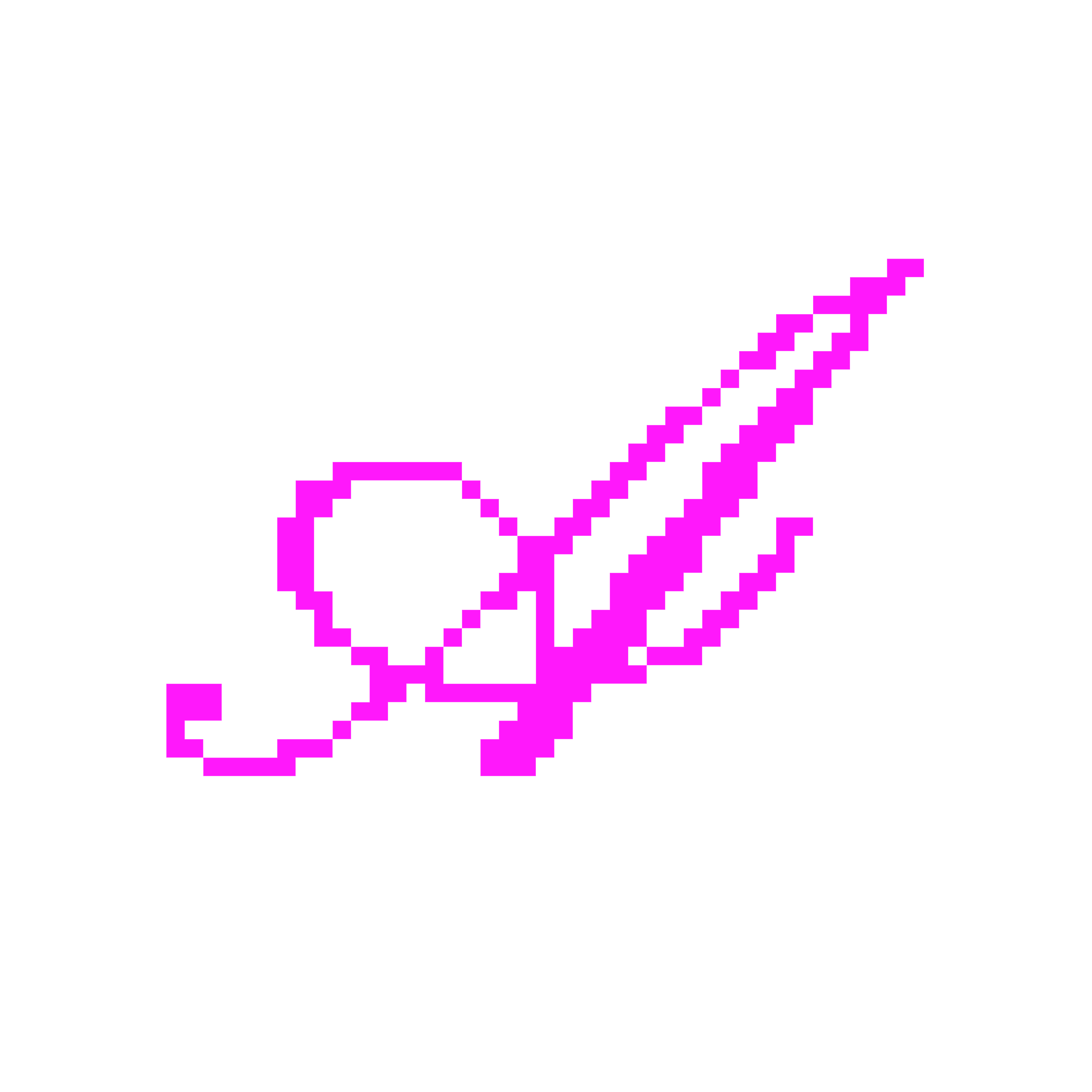
Emily Dickinson used dashes the way other poets used metaphor: however the f*ck she felt like it. Short ones, long ones, slanted up or down. Scholars spent more than a century arguing about what they meant. Some believed they indicated pauses for breath when reading aloud. Others argued they marked emotional intensity — the places where language strained against what could be said. Paul Crumbley suggested the dash suggested the dash represented disjunction itself, the fractured quality of selfhood in language. Deirdre Fagan called them markers of "the unutterable," moments where words failed and silence had to carry meaning.
Consider “The Brain— is wider than the Sky—”. The dash following “Brain” produces a momentary suspension that withholds classification, while the dash following “Sky” blocks syntactic closure, indicating that the comparison remains open-ended beyond the limits of the line. They make you stop and reconsider what you just read. They create a visual interruption that mirrors the conceptual shock of the claim itself. Ben Lerner describes Dickinson’s dashes as “markers of the limits of the actual, vectors of implication where no words will do.” For some people, Emily's use of dashes made absolutely no sense. For others, every dash carried as much meaning and interpretation as we allow every word in poetry to hold.
For Dickinson, the dash represented what could not be spoken cleanly. A mind in motion. A thought interrupting itself. An emotion too large for the sentence containing it but too nuanced to be ended in other punctuation. The dash was human expressiveness at its most raw. While the symbol is now commonly associated with AI writing, the underlying logic is typically unrelated. Dickinson’s dashes reflect intentional interruption; model-generated dashes that we see in today’s LLM output more likely reflect statistical preference, not a mind straining against life with language but a system optimizing for the patterns it has seen most often.
The em dash is only one example of where contortion or misuse becomes venerated. Many writers have used weird or wrong punctuation as a way to capture the stutter and lurch of thought, or the way feeling appears in spikes rather than in smooth arcs. Think of confessional poets who let line breaks fall in jarring spots. Think of diarists who trail off mid-sentence. Think of experimental novelists who leave whole pages unpunctuated and then suddenly drop a swarm of commas into a single paragraph. Punctuation, specifically the irregularity of it, has always been appreciated in writing. It signals that the writer is wrestling with something alive. It is a record of thinking in progress.
We have always used these small anomalies as clues that a real person is behind the page. When a sentence sounds slightly wrong in the right way, we lean in. We assume there is a mind at work that is not simply following programming of large-language models. That assumption is now under strain. The same marks and rhythms that once read as human texture are being re-coded as possible evidence of a machine design.
The New(ish) Marks of Suspicion
The New(ish) Marks of Suspicion
Once language models became public, anxiety about authenticity spiked fast. Teachers worried about essays that didn't sound like their students. Editors worried about pitches that felt generic in a new way — the right words in the right order, somehow emptied of whoever supposedly wrote them. Platforms worried about floods of content written by no one about nothing. Ordinary people worried about being fooled by writing in the most common settings: texts, emails, internet posts. Out of that mix came a new kind of social capital: the ability to spot machine text. Pattern recognition as knowingness.
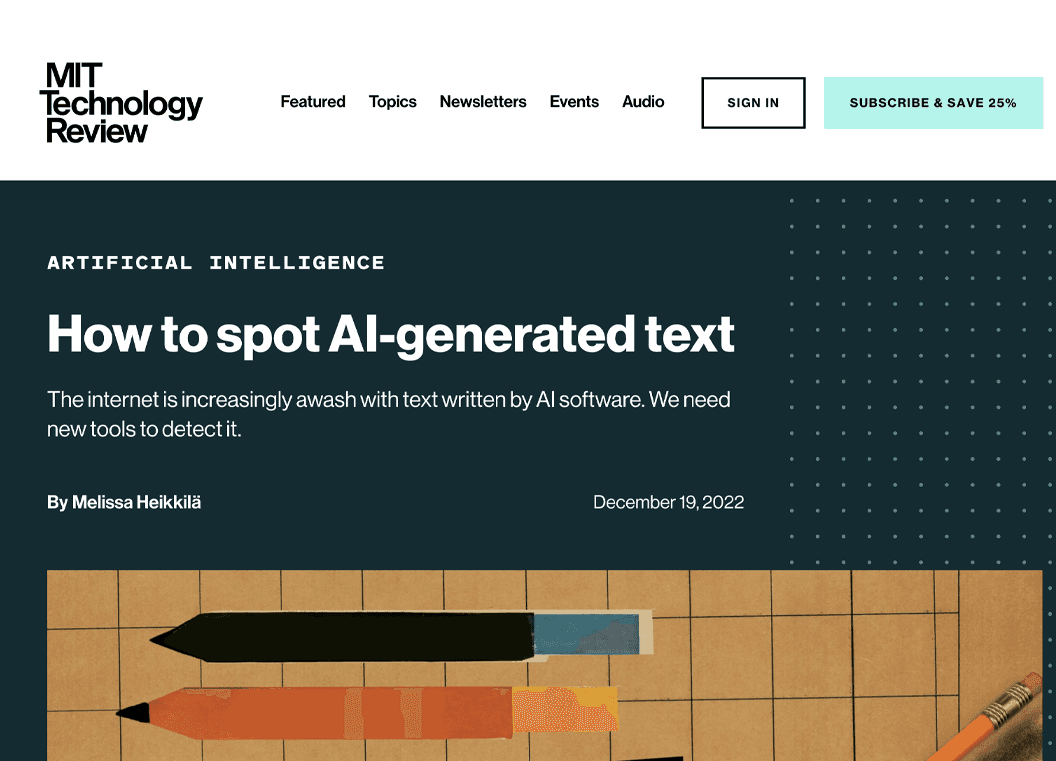
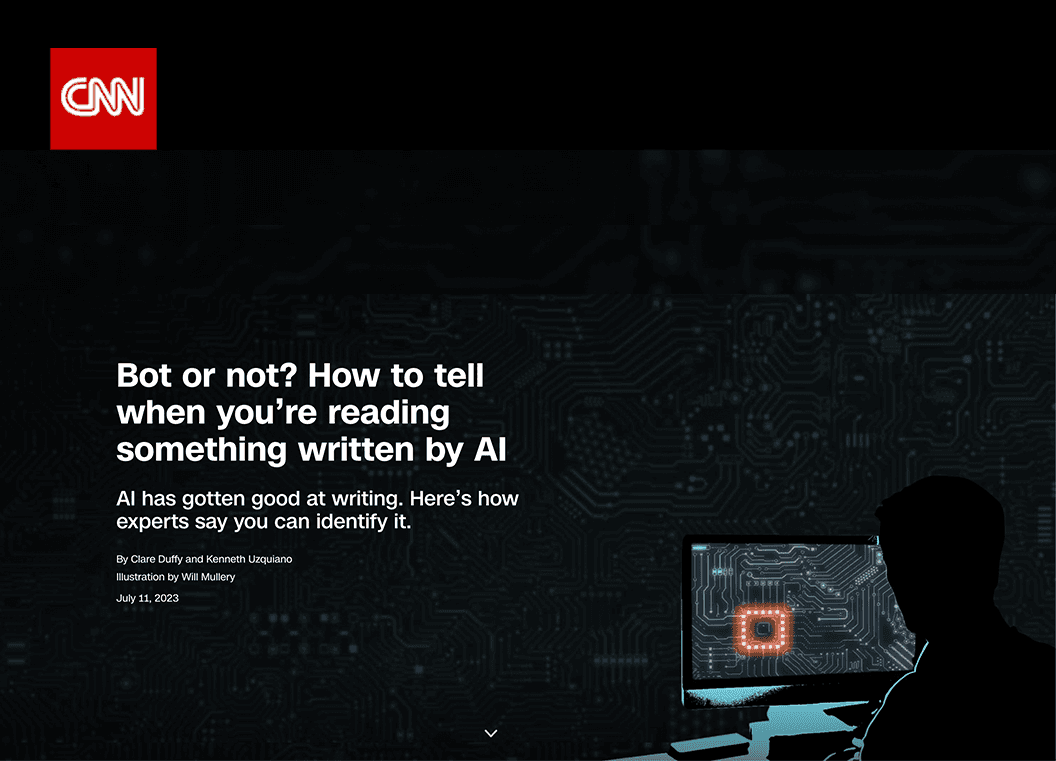
Wikipedia's editors were among the first institutions to formalize what everyone was already doing informally. By late 2024, they had compiled a public field guide titled “Signs of AI Writing,” a detailed catalog of patterns observed across thousands of instances of machine-generated text and documents what LLM output typically looks like in practice. Wikipedia was not alone. Across articles, blogs, and other media, hundreds of writers and researchers had independently compiled their own lists of AI "tells" built from the same collective obsession with catching machine text in the wild.
The five signals below represent some of the most common and consequential markers. Each one was once a legitimate rhetorical choice. Each one is now grounds for suspicion.
Large language models use the em dash more frequently than human writing, and they deploy it in places where humans would typically choose commas, parentheses, or colons. More importantly, LLMs use em dashes in a formulaic way, often mimicking “punched up” sales language by overemphasizing clauses or creating false parallelisms (which we get into later.)
In November 2025, OpenAI CEO Sam Altman publicly acknowledged the issue. He posted on X: “Small but happy win: If you tell ChatGPT not to use em dashes in your custom instructions, it finally does what it’s supposed to do!”. Responses to this describing the dash as one of the model’s most recognizable stylistic habits and portraying its reduction as a kind of quality-of-life improvement for users tired of that particular tic. More significantly, the announcement validated what many were thinking: the em dash had become a public issue. ChatGPT’s official Threads account even posted about its, admitting it had “ruined the em dash.” The phrasing was telling. It can be argued however, that a punctuation mark does not get ruined by being used. It gets ruined by being turned into evidence.
Writers who love the em dash for legitimate reasons — for rhythm, for emotional nuance, for the ability to hold two thoughts in tension — now avoid it. The mark that Emily Dickinson used to signal ambiguity and emotional depth is now a liability.
Humans use negative parallelism all the time but perhaps never knew what it was called. “It’s not x, it's y.” The structure reframes an assumption very clearly. It tells the reader: you thought it was this; it is actually that. The contrast creates emphasis. The use of this device traces back to secondary education, right when we became obsessed with the concept of juxtaposition after our first lit class. It's an effective way to present a point, but it shouldn't be the only way.
LLMs reproduce this structure frequently, and they do so in predictable ways. We’ve noticed that AI-generated text in both writing and chat includes phrases like “That’s not…, that’s…” or “This is not…, this is…” over and over, often without the rhetorical sophistication that justifies the structure in human writing. It feels like this is done for the assumed impact and emphasis, not built from thoughtful intent.
Detection culture now reads this structure as suspicious. When a human writer uses negative parallelism to make a sharp rhetorical point, readers conditioned to (or that have been exposed to) AI writing may classify it as such. In this environment, intent becomes gradually irrelevant; models and detectors default to surface-level “aura-farming” rather than meaning or syntactic purpose.
This creates a philosophical bind. Negative parallelism is useful precisely because it mimics how humans think through problems. We correct ourselves. We reframe. We say “wait, actually it is this other thing.” Machines learned this pattern from us. We are now being told we sound like machines when we sound like ourselves.
The rhetorical implications matter. If writers avoid negative parallelism to evade suspicion, they lose a tool for clear argumentation. The structure does conceptual work. Removing it flattens the thinking.
LLMs have a technical tendency toward balance, because symmetrical structures score well in probability distributions trained on human text. Three is where that tendency lands most often. Two feels like a comparison. Four feels like a list. Three feels like a complete thought— the minimum required to suggest comprehensiveness without actually achieving it. Three adjectives in a row. Three short phrases separated by commas. Three examples to prove a point. The pattern appears everywhere in machine-generated text because it creates a sense of completeness without requiring deep analysis.
This can take different forms, from “adjective, adjective, adjective” to “short phrase, short phrase, and short phrase.” The structure makes superficial analyses appear more comprehensive than they actually are. You see it constantly: “The platform is intuitive, powerful, and scalable.” “The team demonstrated creativity, resilience, and strategic thinking.” “We need to innovate rapidly, communicate clearly, and execute flawlessly.” Three beats. Three items. Always three.
The rule of three has legitimate rhetorical power. “Life, liberty, and the pursuit of happiness” works because the third element surprises and expands. “I came, I saw, I conquered” works because the progression builds momentum. Classical rhetoric used triadic structures to create rhythm and emphasis. LLMs use the rule of three differently. They often deploy it as filler, as a way to pad sentences and create false substance. The three items rarely build toward anything. They just sit there, equally weighted, claiming completeness through repetition.
Writers who actually think in threes, who use triadic structures to build arguments or create rhythm, now face suspicion. The pattern has been so thoroughly associated with LLM writing that using it well requires extra justification. You have to prove you meant it. Some writers may have started deliberately breaking their threes. They write four examples instead. They use two adjectives or five. They vary their lists to avoid the telltale pattern. The rule of three, one of the oldest devices in rhetoric, becomes something to hide.
One of the subtler but more damaging signals is tone. LLM output tends toward a specific emotional register: warm but restrained, helpful but measured, polite without intimacy. The models are fine-tuned to avoid extremes. They stay in a narrow emotional band designed to feel safe and pleasant. It's what we used to describe as "robotic" and while it's quite different than how we used to perceive it, the seemingly perfect distribution of tone can still appear lifeless.
This creates a tonal signature. When writing maintains the same level of emotional temperature throughout, never spiking into frustration, never dropping into vulnerability, it starts to feel synthetic. Readers sense the lack of range even if they do not consciously identify it.
Humans write differently than that, especially when stakes are high. Emotional range shifts and humanity emerges. A paragraph might start calm and analytical, then turn sharp with irritation, then soften into reflection and calm. Tone follows thought. When tone stays perfectly modulated, it signals control that feels inhuman. It creates writing that doesn't always resonate. Writers may now flatten their own emotional range under scrutiny. They worry that showing too much feeling will seem artificial, that expressing frustration or joy too openly will read as manufactured warmth. They edit themselves into blandness.
This may be the most significant loss. Emotional range makes writing worth reading. It signals another person behind the words. When fear of suspicion drives writers to suppress their own tonal variation, the result goes beyond duller prose. Voice itself gets erased, seemingly void of ego, persona, identity.
Shame and What It Changes in Writing
Shame and What It Changes in Writing
Shame is one of the most efficient regulators of human behavior. It does not require rules or enforcement - just the possibility of being seen a certain way. You type a line that feels a little too smooth and immediately wonder whether it sounds like you or a model. You imagine your peers thinking this isn't how you write. You imagine an editor assuming you pasted directly from chat response. You imagine a friend reading your message and deciding it feels off in a way that suggests you did not really care enough to write it yourself. Perhaps you did you use AI to help you write. Perhaps it saved you time or helped you convey your thoughts more clearly - it doesn't matter. So you adjust, again and again.
AI shame is different from other forms of writing anxiety. Research by Advait Sarkar defines AI shaming as “a social phenomenon in which negative judgements are associated with the use of artificial intelligence,” including comparing someone’s work to AI output as disparagement, voicing suspicion to undermine reputation, or blaming poor quality on AI use. Being mistaken for a machine is treated as a comment on your character: your effort, your honesty, your seriousness, and your integrity. You do not want to be seen as lazy or hollow. So you install a detector inside your own head and let it judge in advance.
But this only happens once you've eaten the apple. You have to know what AI writing looks like before you can fear being mistaken for it. That awareness, once gained, cannot be undone.
This is rational behavior in an environment where authenticity is constantly questioned. The rationality makes the problem worse. When millions of writers police their own style to avoid shame, the cumulative effect is a fundamental rewriting of what counts as acceptable human expression. Here are some mechanisms by which AI shame is changing how humans write:
↳ Downshifting Intelligence and Vocabulary
Writers self-limit. Softer vocabulary. Simpler clauses. Fewer syntactic turns. Intentionally imperfect phrasing. Deliberate rough edges. The goal is no longer clarity. The goal is plausible imperfection.
This is a new aesthetic: the performance of fallibility. A model of humanity based on strategic underperformance. You flatten emotional intensity because you have started to read strong feeling as corny machine mimicry, even when it comes from you.
🔗
u/machyume on Reddit
"Stop learning from Al. You will start to speak like an Al, and your word choice and tone will trigger detectors. If you want to sound more human, you will have to use more broken English."
🔗
u/machyume on Reddit
"Stop learning from Al. You will start to speak like an Al, and your word choice and tone will trigger detectors. If you want to sound more human, you will have to use more broken English."
↳ The Collapse of Emotional Register
Strong feeling, once a mark of human intensity, now reads as synthetic. Writers dampen affect. Avoid warmth. Avoid enthusiasm. Avoid lyricism. Avoid intensity. Emotion becomes suspicious because models can simulate it convincingly. People learn to mute the very signals that once marked humanity.
The em dash that used to signal breath and emphasis now signals possible inauthenticity. The negative parallelism that used to create rhetorical contrast now signals possible laziness. Emotional warmth now signals possible LLM generation. What remains is prose that sounds like someone trying very hard not to sound like anything in particular.
↳ The Paradoxical Drift Toward Machine Likeness
The more humans try to avoid sounding like AI, the closer they get to a machine baseline. Flattened tone. Low variation. Shorter sentences. Predictable rhythm. Generic structure. Avoidance becomes mimicry. Fear produces the outcome it set out to prevent.
Writers flatten their style to avoid being read as machines. In doing so they produce writing that feels less human. They remove the very qualities that used to distinguish human prose from generic output: idiosyncrasy, tonal variation, stylistic risk. The fear of sounding artificial makes them sound more artificial. This is the aesthetic of self-erasure.
Something shifts when suspicion enters the process of writing. The page stops being a place where ideas unfold freely. It becomes a surface under examination, communication under surveillance. Every small gesture you make feels exposed: an em dash, a tonal spike, a sudden pause. You sense an external gaze before any reader arrives. Every decision you make bends toward that anticipation, and that slowly erodes the humanity you felt compelled to defend.
Human expression has always carried irregularities— always imperfect. A sentence jumps in intensity without warning. A thought arrives out of order and lands on the page exactly that way. Heat in one place, cold in another. Readers used to treat those shifts as evidence of a mind pushing against its own limits. The irregularities created texture for human writing. They allowed us to identify patterns attached to individuals, groups, communities. They made words feel alive with access to the full gamut of emotions shared by the individual(s) behind them.
What gets lost is the dash that holds thoughts in suspension. The tonal change that shows you care enough to break your own rhythm. The structural risk of building a sentence that lands wrong in a way that makes someone stop— in a way that confuses. The willingness to let a thought arrive messy and stay that way because cleaning it would kill what it was trying to say. These choices do real work for us as people. They show how we control language. They give writing contour so when you strip them out to pass an invisible test, the writing thins. Eventually it disappears into something that could have come from anywhere, written by no one, carrying nothing worthy of attention.
Emily Dickinson used dashes because they let her say what could be said no other way. The dashes were hers. Nobody in 1862 accused her of sounding like anyone else. She had a style. That meant something then. It still does now.
The question is whether you are willing to claim a style of your own. Suspicion will come. People will bring their diagnostics. You cannot control that. What you can protect is your ability to place marks on a page that carry pressure, breath, digression, contradiction, urgency, softness. All the shifts that happen inside a mind— no, a soul, moving through language.
The machines will keep learning. The detection methods will keep evolving. The lists will keep growing. What remains constant is the choice: write with the full range of your expressive habits, or edit yourself into something safer and smaller and more forgettable.
Writing that keeps its irregularities preserves the space where a mind can appear. That persistence—quiet, steady, unashamed—is what we keep.